



Know your patient’s advanced breast cancer with NGS testing.

Recognize the impact of actionable alterations.
Understand the prevalence and impact of PIK3CA, AKT1, and PTEN alterations in HR+/HER2- advanced breast cancer.


Uncover the potential of NGS testing.
Learn how NGS testing can open more possibilities for your patients.

Discover best practice on testing in advanced breast cancer.
Explore an overview of NCCN Clinical Practice Guidelines In Oncology (NCCN Guidelines®) recommendations.

Uncover key actionable biomarkers in advanced breast cancer with NGS testing.1,2
PIK3CA, AKT1, and PTEN alterations can be predictive of treatment resistance in advanced breast cancer.3–5,a
The PI3K/AKT/PTEN pathway mediates critical cellular processes, such as cell proliferation, cell survival and cell metabolism, and is relevant in HR+/HER2- advanced breast cancer.3–5,a
Hyperactivation of PI3K/AKT/PTEN pathway signaling promotes resistance to many breast cancer treatments, including endocrine therapies (ET) and CDK4/6is.3–5
Most patients with HR+/HER2- advanced breast cancer experience disease progression on ET ± CDK4/6i.6


Adapted from Paplomata E, O’Regan R. Ther Adv Med Oncol. 2014;6(4):154-166.
Alterations leading to hyperactivation of the PI3K/AKT/PTEN pathway in HR+/HER2- advanced breast cancer.3,7–9
| Gene | Key genomic event | Change in protein function |
|---|---|---|
| PIK3CA | Point mutations of PIK3CA | Gain of function of PI3K |
| AKT1 | Point mutation of AKT1 | Gain of function of AKT |
| PTEN | Point mutations, large deletions, and genomic rearrangements involving PTEN | Loss of function of PTEN |
NCCN Guidelines® recommend testing for PIK3CA, AKT1, and PTEN alterations in eligible patients with HR+/HER2- advanced breast cancer.10
Take a closer look at common drivers of disease progression in patients with HR+/HER2- advanced breast cancer.3,8,9,11
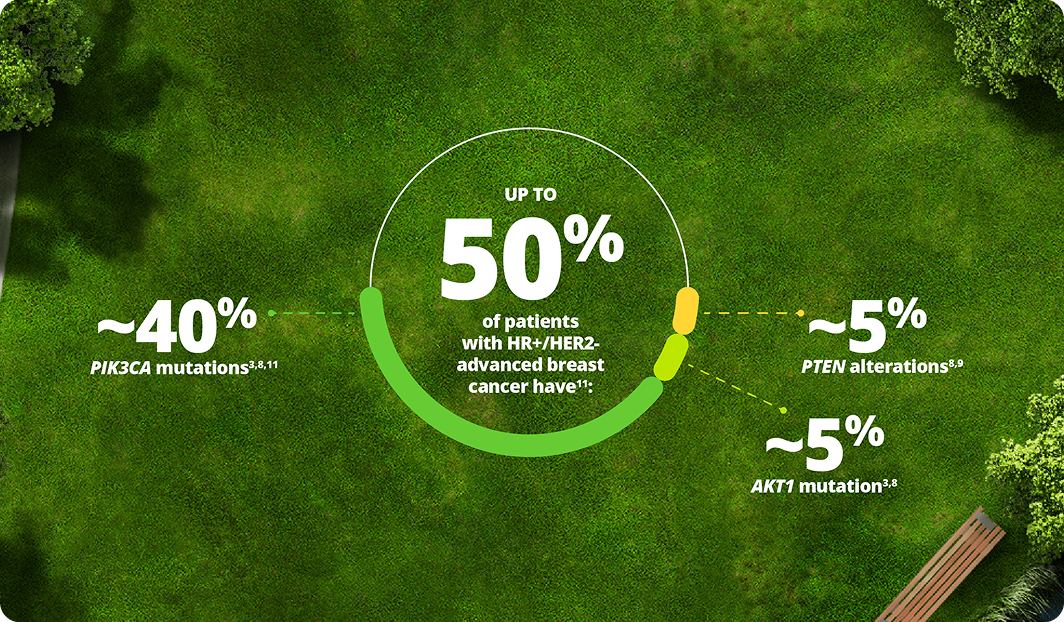
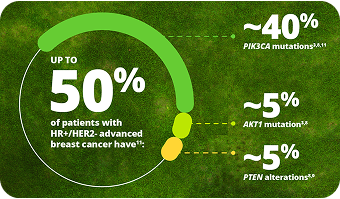

Never miss a mark in advanced breast cancer.
Uncover actionable alterations such as PIK3CA, AKT1, and PTEN with NGS.10

Get a detailed picture of your patient’s advanced breast cancer with NGS.
Testing for actionable biomarkers, including PIK3CA, AKT1, and PTEN alterations, can provide a detailed picture of a patient’s HR+/HER2- advanced breast cancera and guide their clinical management.7,10,12–14
For patients with recurrent or metastatic breast cancer, the NCCN Guidelines recommend comprehensive germline and somatic profiling, such as next-generation sequencing (NGS) testing.10
NGS can give you access to:


Predictive information
Hyperactivation of the PI3K/AKT/PTEN signaling pathway drives resistance to endocrine therapies.3,4
Indicates likelihood of response to certain targeted treatments.5
Prognostic information
In mBC, PIK3CA mutations have been linked with aggressive disease and poor prognosis.12,15
In breast cancer, emerging evidence suggests PTEN alterations may be associated with progression and poor prognosis.16


Which can inform:
Treatment eligibility
Informs eligibility for FDA-approved targeted treatments.10
Trial eligibility
Informs clinical trial eligibility for targeted treatments.7,13
The NCCN Guidelines currently recommend NGS testing for the following biomarkers in advanced breast cancer.10,a
Biomarkers with FDA-approved therapies:
- PIK3CA activating mutations
- AKT1 activating mutation
- ESR1 mutations
- PTEN alterations
- NTRK fusion
- MSI-H/dMMR
- TMB-H
- RET-fusion
Evolving treatment options are rewriting the rules of who may be eligible for targeted therapy; ensure no appropriate patients miss out.
The biomarker-driven treatment landscape is continuously evolving, increasing the number and type of patients now eligible for personalized treatments selected by NGS testing.17,18 With increased options, more patients have the opportunity to access targeted treatments for their cancer than ever before.


Despite its potential to inform treatment decisions, not all patients receive NGS testing.19–21


Although some evidence suggests that NGS testing rates are steadily increasing in clinical practice,19,22 a retrospective observational study assessing NGS testing patterns found that only 40% of patients with mBC received testing between 2017 and 2023.21,b
Ensure your eligible patients don’t miss out.
How can you make more informed treatment decisions with NGS testing?
Be prepared for disease progression with early NGS testing.
Test all eligible patients with advanced breast cancera at diagnosis to help inform future clinical decision-making upon disease progression.10
NCCN Guideline recommendations for initial patient work-up for advanced breast cancer10,a:
When?
Initial workup for patients with stage IV (M1) or recurrent unresectable breast cancer.
How?
Comprehensive germline and somatic profiling techniques, such as next-generation sequencing (NGS) panel testing.
Consider starting the discussion on standardizing reflex NGS testing protocols with your MDT.
Start a discussion with your MDT about whether incorporating reflex NGS testing during the initial patient workup could enhance your institution's ability to provide guideline-concordant care.23
Reflex protocols simplify the testing process, reduce wait times for test ordering and may improve testing rates, helping to increase the number of patients identified for targeted therapy.23–25
Be prepared. Test at metastatic diagnosis with NGS.